


- Experience across many industries shows that natural refrigerants can be used safely and efficiently
- ECOOLTEC’s safety concept: minimal refrigerant quantities and separation of refrigeration generation and distribution
- Tighter F-Gas Regulation is driving a significant rise of interest in the use of natural refrigerants with a practically zero greenhouse warming potential
Due to the stricter F-Gas Regulation, interest is growing in refrigerants with the lowest possible global warming potential. Natural refrigerants such as propene, which ECOOLTEC uses, have a negligible GWP and are therefore very climate-friendly. However, hydrocarbons are flammable, but thanks to ECOOLTEC’s comprehensive technical safety concept, they can be used in transport refrigeration, not only sustainably and economically, but also safely. This is demonstrated by their extensive use over many decades in domestic, commercial and industrial applications.
Whether in fridges, air-conditioning systems, cold stores or trains – the use of natural refrigerants is widespread. The refrigeration industry has long had extensive experience in using these substances, they were successfully employed right from the very beginning of refrigeration. Today, they are once again the first choice in many stationary as well as mobile applications due to their environmental benefits and cost-effectiveness. “Ammonia (R717) is used in industrial applications; in domestic appliances, isobutane (R600A) is widely used as a refrigerant; and in supermarket and industrial cooling, CO₂ (R744) has been specified for many years.
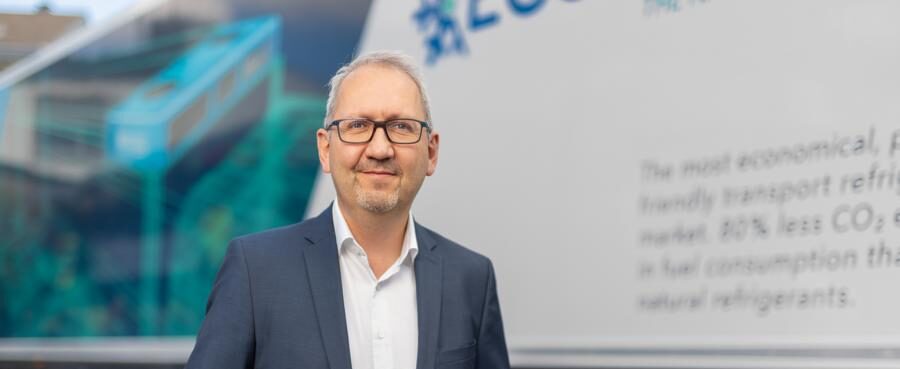
These examples demonstrate that refrigerants with demanding characteristics can be operated safely and effectively if system design and risk management are developed in tandem”, argues ECOOLTEC CTO Holger Dörre.
“Even in rail transport, the European railway industry has switched to propane as a refrigerant for both economic and environmental reasons. Single-circuit systems are frequently used in this context. To prevent flammable refrigerant from entering the passenger compartment in the event of a leak, the safety concept is designed to combat that, as any evaporator section leak is vented to the outside air. Even with higher refrigerant volumes, reliable safety concepts can be implemented in this way”, reports Holger Dörre, who has developed and supplied such systems for this application throughout his professional career.
Minimal refrigerant quantities and correctly specified control measures mitigate risks
Nevertheless, there is still some concern in the transport industry about flammable refrigerants, however, any risk is based on the specific amount of refrigerant, unit design, and installation situation. Well-designed system concepts such as those developed by ECOOLTEC rely on minimal refrigerant quantities, structural measures for leak control and the separation of refrigeration primary and secondary circuits.
The fully electric ECOOLTEC TM182 transport refrigeration unit uses only CO2 (R744) and propene (R1270), both of which have a negligible global warming potential (GWP), to generate cold. The refrigeration process using the flammable R1270 takes place entirely outside the body box. There, the natural, constantly present air flow ensures that, e.g. as a result from an impact damage, any propene escaping immediately mixes with the ambient air and dissipates. In the box body, the non-flammable refrigerant R744 ensures the distribution of cold air. The R1270
and CO2 circuits flow past each other outside the body, thermally connected via a plate heat exchanger.
The systems design and construction are the factors that determine risk, not the specific characteristics of the refrigerant itself
Another key component of ECOOLTEC’s risk strategy is the low refrigerant charge. In contrast to conventional systems, the amount of refrigerant used is 90 per cent lower. The TM182 contains only 650 grammes of propene and approximately 1,100, grammes of CO2 per refrigerant circuit. In total, the system has two propene and two CO2 refrigerant circuits. For fleet operators, service companies, and rental and leasing firms, this means what matters is not whether refrigerants are flammable or non-flammable, but which technical measures the manufacturer of the transport refrigeration system has taken to control potential leaks.
Natural refrigerants offer users further advantages. Hydrocarbons are characterised by high energy efficiency in the refrigeration process and, in addition to good availability at a competitive price, also facilitate a significant reduction in operating cost. “With natural refrigerants, fleet operators therefore have a sustainable, efficient and safe alternative to F-gases, which were initially thought to be a non-flammable and non-toxic alternative, but which are now known to pose major risks to the environment and health, which is why European legislators are taking decisive action against their use”, explains the ECOOLTEC CTO.
EU imposes restrictive regulations on the use of F-gases with high global warming potential
“This is not the only reason why the interest in natural refrigerants is significant and growing in temperature-controlled road freight transport. Another key driver is the stricter F-Gas Regulation (EU) 2024/573. It will further restrict the use of common F gas refrigerants such as R452A and R410A, which have a GWP of over 2,000, and
phase them out completely by 2050 at the latest”, explains Holger Dörre. It should also be borne in mind that even modern fluorinated refrigerant blends, which take GWP reduction into account, are also flammable.
The revised version also provides for a significant acceleration in the reduction of remaining quantities (phase-down) leading up to a general ban on use. According to the regulation, the currently regulated quantity of synthetic refrigerants with a high GWP is to be reduced by 95 per cent by 2030, relative to the base year 2015. At the same time, the F-Gas Regulation will see the production of HFCs gradually reduced to 15 per cent of the 2015 baseline level from 2036 onwards, within the framework of production quotas allocated by the European Commission.
Shortage of F-gases threatens operational safety and increases costs
“Although transport refrigeration systems are not yet affected by a premature ban on synthetic refrigerants, as is the case with numerous stationary applications, fleet operators are already facing significantly rising operating costs and limited availability of conventional refrigerants due to the F-Gas Regulation”, reports Holger Dörre. “The phase-down could jeopardise the operational safety of existing systems if sufficient quantities are no longer available when servicing is required”, says the refrigeration expert. According to Dörre, this is particularly true given that refrigerated vehicles are typically operated in a fleet for up to twelve years and often spend their second life in other EU countries.
In addition to the global warming potential of F-gases, regulatory authorities are also focusing on their adverse effects on human health when they enter the atmosphere. F-gases belong to the group of substances known as per- and polyfluoroalkyl substances (PFAS). The REACH Regulation (EC) No. 1907/2006 governs the use of such chemicals and could therefore also be applied to F-gases in the future. It is therefore possible that the REACH Regulation may even ban the use of F-gases as refrigerants before the F-Gas Regulation comes into force.
An F-gas-free supply chain is already possible today and safe in operation
“Thanks to our both innovative and sustainable technology, which is unique in the heavy-duty vehicle segment so far, all operators of refrigerated vehicle fleets already have the option today to switch to transport refrigeration systems that generate cold exclusively using natural refrigerants”, says the ECOOLTEC CTO. By taking this step, fleet operators avoid operational uncertainties and, despite the flammability of R1270, do not expose themselves to any unmanageable or increased safety risk.
Transport & Logistics Magazine – Driving The Industry Forward