

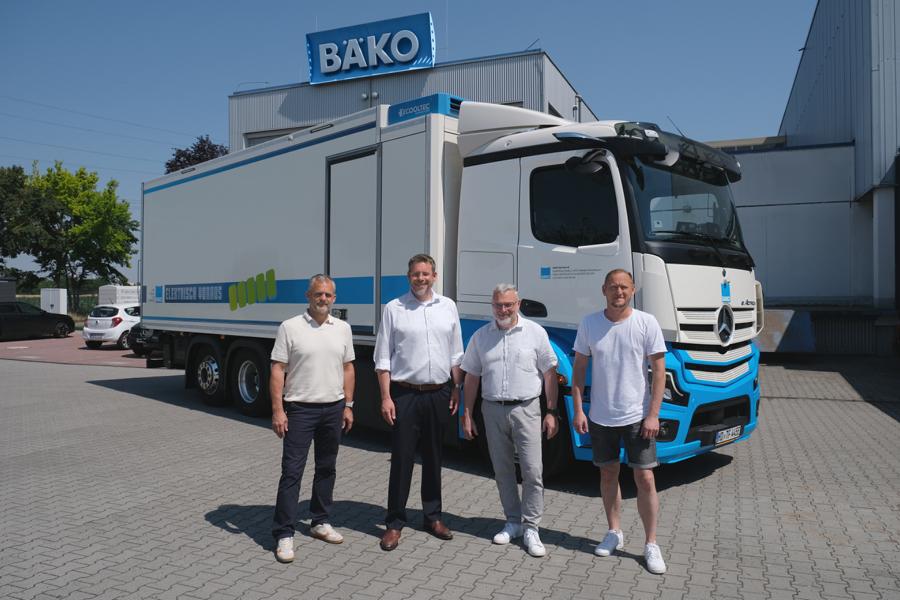
- Jochen Früauff, Managing Director of BÄKO Süd-West: “The decision to use electric trucks equipped with the ECOOLTEC transport refrigeration system marks a logical step for us towards sustainable, low-emission logistics.”
- Electric trucks fitted with the TM182 are all-rounders in day-to-day operations and offer the company a sound economic return • The installation position and design of the ECOOLTEC system provide BÄKO Süd-West with decisive advantages in practical transport operations
- BÄKO Süd-West has taken delivery of two Mercedes-Benz eActros 400s provided with the ECOOLTEC TM182 transport refrigeration unit. This is a special first for the wholesale bakery supplier and for ECOOLTEC: These are the first two fully electric trucks in Germany featuring the equally fully electric ECOOLTEC transport refrigeration unit. For Jochen Früauff, Managing Director of BÄKO Süd-West, these fully electric, highly sustainable trucks are not a niche solution, but all-rounders whose use also make economic sense for the company.
BÄKO supplies bakers and confectioners with everything they need for their businesses – from raw materials, retail goods and packaging materials to machinery and shop fittings. The cooperative’s product range comprises around 16,000 items, which are transported at ambient, chilled or frozen temperatures.
BÄKO Süd-West, based in Edingen-Neckarhausen near Mannheim, is one of 25 regional cooperatives and now delivers its range in a particularly climate-friendly manner. To this end, the company operates several fully electric trucks.
The fleet now also includes two three-axle Mercedes-Benz eActros 400s fitted with a multi-temp body from Karosseriewerk Meyer and the ECOOLTEC TM182 transport refrigeration unit. Neither the two trucks nor their transport refrigeration systems – which are powered by the battery drive via the rigid’s DC-ePTO – emit any pollutants or CO2 whilst in operation. Furthermore, the ECOOLTEC systems generate refrigeration exclusively using the natural refrigerants R1270 (propene) and R744 (CO2). Compared with the fluorinated refrigerants R452A and R410A, which have been predominantly used to date and have GWP (Global Warming Potential) values of more than 2,000, these have a negligible global warming potential of no more than one.
First electric truck with an ECOOLTEC transport refrigeration system in Germany
The fully electrified system, which meets the environmental and economic requirements of modern transport chains, was a decisive factor in the procurement decision for Jochen Früauff, one of the two Managing Directors of BÄKO Süd West. “The Mercedes-Benz eActros 400 with the ECOOLTEC transport refrigeration system marks a logical step for our company towards sustainable, low-emission logistics. This project involves a great deal of pioneering work. But for us, the vehicle is not a flagship project or a niche solution, but an all-rounder capable of handling all our routes. In doing so, we are creating a blueprint for future electric refrigerated truck transport that combines efficiency and sustainability”, he explains.
BÄKO Süd-West’s delivery area extends as far as Frankfurt, Buchen in the Odenwald, Karlsruhe and Pirmasens. Routes can be around 300 kilometres long and include up to 15 drops. The TM182 is specifically designed for the most demanding tasks. “ECOOLTEC‘s technology has convinced us of its performance. We don’t have to compromise on quality, temperature control or range”, confirms Jochen Früauff.
As well as sustainability, cost-effectiveness must also be right
But ultimately, it has to make financial sense, too. “We’re a business; for us, economic benefit comes first. No customer wants to pay extra for us to deliver their goods using a zero-emission truck”, explains the Managing Director. That is why he and his fleet and sustainability team – comprising Sustainability Officer Martin Schuster, Fleet Manager Oleg Anschütz and Sven Strauch, who is responsible, amongst other things, for managing logistics services and fleet management – crunched the numbers very carefully at the start of the project. “The fixed costs are higher than for comparable diesel-powered models due to the higher purchase price of the battery-electric truck. However, the variable costs are significantly lower, so that, on balance, we have calculated the total cost of ownership to be at a similar level. We charge using our own solar-generated electricity, do not require AdBlue, are exempt from tolls on 60 per cent of our routes, and the maintenance costs for electric trucks and the ECOOLTEC refrigeration system are comparatively low. Furthermore, natural refrigerants cost significantly less than F-gases when servicing is required”, reports Managing Director Früauff. With regard to the ECOOLTEC technology, he anticipates potential savings of at least 4,000 euros per year per vehicle.
Initially, however, the use of natural refrigerants was, for him, just one part of ECOOLTEC’s innovative technology package and not the decisive factor in the purchase. Due to the shortage of refrigerants caused by the F-Gas Regulation, prices for synthetic refrigerants with a high GWP have risen sharply. “This makes servicing conventional transport refrigeration systems considerably more expensive. Consequently, the European regulations governing refrigeration systems now have a major influence on our decisions”, adds Oleg Anschütz. The “BW-e-Nutzfahrzeuge” subsidy scheme run by the state of Baden-Württemberg ultimately made the difference. The state subsidised the maintenance and operating costs of the two trucks with 60,000 euros. As a result, the fully electrified refrigerated vehicles are now significantly cheaper to run than diesel models.
Drivers praise the smooth running and easy use of the system
What’s more, BÄKO Süd-West is not subject to any entry restrictions in low emission zones when using these vehicles. According to Jochen Früauff, the customers’ reactions are priceless. “They’re delighted when we deliver with the electric trucks. It’s brilliant for our image!”, he says. The drivers are also very satisfied with the zero-emission trucks. “Above all, they praise the quiet operation of the transport refrigeration units”, reports fleet manager Anschütz.
The drivers are also impressed by how easy the TM182 is to use. “As the system can be controlled via a central control panel and just a few button commands, it’s easy to learn how to operate it”, he reports.
The TM182’s compact design really comes into its own at BÄKO Süd-West
Further factors in favour of the TM182 include the site- and operation-specific requirements of BÄKO Süd-West. “The location in an established industrial estate places particular technical demands on our trucks”, explains Oleg Anschütz. Access to the warehouse is restricted, meaning that trucks must not exceed 10.15 metres in length in order to reach the loading points without difficulty. At the same time, the trucks must not exceed a certain height in order to access all loading points. A front-mounted refrigeration unit would therefore require a shorter body, thereby reducing the number of loading points available. Conventional refrigerated transport systems, which are integrated into a roof, in turn reduce the loading height to less than 1.9 metres, meaning that neither roll containers nor fully loaded pallets can fit beneath the ceiling evaporator. “The ECOOLTEC system enables us to maintain our usual level of performance“, says Managing Director Früauff.
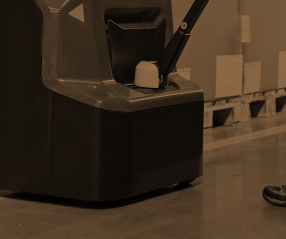
The TM182 has an extremely low profile of just 250 millimetres. Thanks to its compact design, it can be integrated into the box body without any significant loss of load volume. Underfloor refrigeration systems are also out of the question for the Fleet Manager, as electric trucks with a short wheelbase offer barely enough space due to the battery packs.
Jochen Früauff: “We need reliable policies to decarbonise”
The specific operational conditions at BÄKO Süd-West are well suited to the operation of electric trucks: “The vehicles set off on their rounds early in the morning and return to the depot as early as 1 pm, meaning that – particularly during the summer months – they can be charged directly for a further six hours using clean, climate-friendly electricity from our own photovoltaic system”, reports Sven Strauch. The system on the warehouse roofs generates just over 700 kWp – enough to charge the trucks for their next journey. To date, BÄKO Süd-West operates four charging points, each with a maximum charging capacity of 360 kW. The charging infrastructure has also received a grant, in this case from the federal government via the Energy and Climate Fund special fund, totalling 56,000 euros.
“We want to play our part in decarbonising the logistics sector and convert even more vehicles to electric power. However, our procurement is guided by the charging infrastructure that is technically feasible”, says Jochen Früauff. Although the company intends to upgrade its transformer and expand the low-voltage main distribution board in order to install additional charging points and replace further diesel trucks with battery-electric models, even then the available electricity supply will not be sufficient to convert all of its nearly 40 commercial vehicles to electric power. The Managing Director also addresses a second point of criticism. “For companies wishing to invest in sustainability, a sustainable subsidy policy is vital. Only with binding long-term commitments can they have planning certainty and operate profitably in the long term. I would like to see more reliability from those in government in this regard”, he urges.
Transport & Logistics Magazine – Driving The Industry Forward