


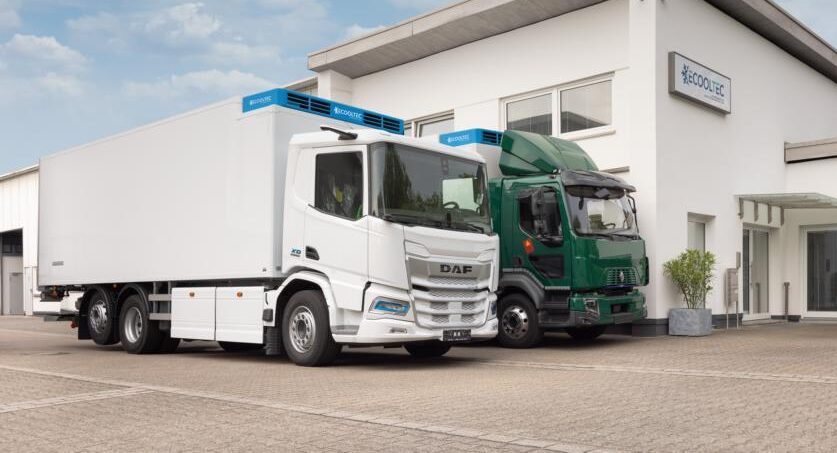
- Most Electric Trucks : Most battery-electric HGV truck models can now be fitted with ECOOLTEC systems
- Updates on components and operating protocols enable the connection of refrigerated transport systems to AC and DC ePTOs • This requires close cooperation with the relevant truck manufacturer. Holger Dörre: “Comprehensive and standardised connections and control elements would be highly desirable.”
The ideal combination is a battery-electric truck equipped with ECOOLTEC’s purely electric driven transport refrigeration units, which exclusively use sustainable natural refrigerants to generate cold. This minimises the impact of temperature-controlled transport on the environment and the climate; however, integrating transport refrigeration systems into electric commercial vehicles presents specific challenges. ECOOLTEC has now successfully overcome those challenges for most of those truck models. At the IAA TRANSPORTATION 2026, the transport refrigeration specialist will showcase suitably equipped commercial vehicles from several brands.
ECOOLTEC has developed a revolutionary and highly sustainable generation of transport refrigeration units for use in commercial vehicles. These can be powered, for example, by the truck’s engine via ECOOLTEC’S integrated high-performance alternator, by the battery of an electric vehicle, or via a land-based cable connected to the mains electricity supply and therefore do not require an integrated diesel engine. Unlike the widely used diesel refrigeration units, the ECOOLTEC transport refrigeration units produce neither local pollutant nor CO₂ emissions when in battery operation, and up to 98 per cent fewer emissions when powered by an ECCOLTEC alternator.
Furthermore, it generates cold exclusively using natural refrigerants. Compared to the fluorinated refrigerants R452A and R410A – which have been predominantly used to date and have GWP (Global Warming Potential) values of over 2,000 – these natural refrigerants have a maximum greenhouse gas potential of 1.
The combination of the ECOOLTEC system and electric trucks is particularly climate-friendly
From an environmental perspective, the ideal solution is to combine the ECOOLTEC system with a battery-electric powertrain. However, this poses considerable challenges for manufacturers of chassis and transport refrigeration systems. ECOOLTEC has now developed solutions for the most common electrically powered HGV trucks – regardless of whether the system is connected via an electric power take-off (ePTO) that generates alternating or direct current. Manufacturers are pursuing different strategies in this regard; only few offer both AC and DC ePTOs. Whilst an AC ePTO supplies electrical power in the same way as a socket on a conventional AC mains supply, the DC ePTO generates direct current with a voltage of between 400 and 800 volts. Accordingly, the refrigeration system must be designed to be flexible to accommodate these various input parameters.
Although connecting the inverter to the relevant ePTO essentially involves a cable connection, there are nevertheless some specific considerations to bear in mind. These relate primarily to communication between the transport refrigeration system and the vehicle’s drivetrain via the CAN bus. The required protocols must be developed individually for each vehicle brand and agreed and approved by the truck manufacturer.
A transport refrigeration system must cool reliably in all operating conditions
Whilst the main challenge with commercial vehicles powered by conventional diesel engines is to integrate the belt-driven alternator into the existing, often limited installation space and to avoid mechanical stresses caused, for example, by vibrations; for electric trucks, operating protocols must be developed in close consultation with the vehicle manufacturer. These are essential to ensure that the system reliably cools the load in accordance with the specifications under all operating conditions of the host vehicle and, for example, maintains the temperature or pre-conditions the load compartment even when the truck is charging at a charging point or has been switched off.
These protocols must be drawn up specifically for each vehicle brand. In many cases, some truck producers also require the driver to carry out the individual operating steps in a specific sequence, to ensure the ePTO does not switch off and the refrigeration unit is therefore always supplied with electrical power. “But the operation of an electrically powered truck must be as simple and convenient as a conventional model. Anything else would be unreasonable”, argues Holger Dörre. Other than that, manufacturer-specific requirements regarding current, voltage and mains frequency must be observed. According to Holger Dörre, further challenges here include the quality of the voltage supplied by the auxiliary power take-off and the leakage and insulation monitoring systems implemented in the vehicle, which do not always operate in accordance with the familiar, traditional industry standards in these new generations of vehicles.
Creating a communication protocol can be a time-consuming process
“These technical challenges can be overcome. However, the time required for the initial development, integration and testing of our systems varies from one vehicle brand to another and can range from a few days to several weeks. This applies to
all brands on the market and is a huge challenge, particularly for a young company like ECOOLTEC. The fact that we now already cover six brands, with a seventh set
to follow shortly, is a great achievement by our team and requires close, trusting cooperation with the OEMs”, says Holger Dörre, CTO of ECOOLTEC. ECOOLTEC will be exhibiting relevant trucks at the IAA TRANSPORTATION 2026 at its own stand A16 in Hall 27 and in the outdoor area J44 I K43, as well as at the stands of several truck manufacturers.
Another distinctive feature concerns battery-electric tractor units. On these vehicles, only alternating current (AC) – and not direct current (DC) – is permitted to flow through the connection between the tractor unit and the semi-trailer. An AC ePTO on the tractor unit is therefore essential in this case. “This variety of vehicle specific refrigerated transport applications and brand-specific operating procedures presents a major hurdle not only for drivers, but also poses significant challenges for sales teams – both on the part of the refrigerated transport specialists and the vehicle manufacturers. Comprehensive and standardised connections and control elements would therefore be highly desirable”, argues Holger Dörre.
Systems for single- and multi-temperature configurations in distribution and long-distance
In addition, ECOOLTEC will be showcasing the E1312 and E1221 flat evaporators at its stand. Whereas the E1312 model is suitable for multi-temperature configurations divided lengthways by a partition in a one-to-two ratio, the single discharge E1221 model is designed for configurations with a one-to-one lengthwise division or for use in combination with a transverse partition.
ECOOLTEC is also unveiling its own remote control with a high-resolution graphic display and the high-performance G30 alternator, which connects the refrigerated transport systems to the truck’s engine. Thanks to the highly flexible ECOOLTEC system, developed in-house, all truck powertrain combinations can be
implemented – regardless of whether they are powered by diesel, natural gas or electricity.
Transport & Logistics Magazine – Driving The Industry Forward