

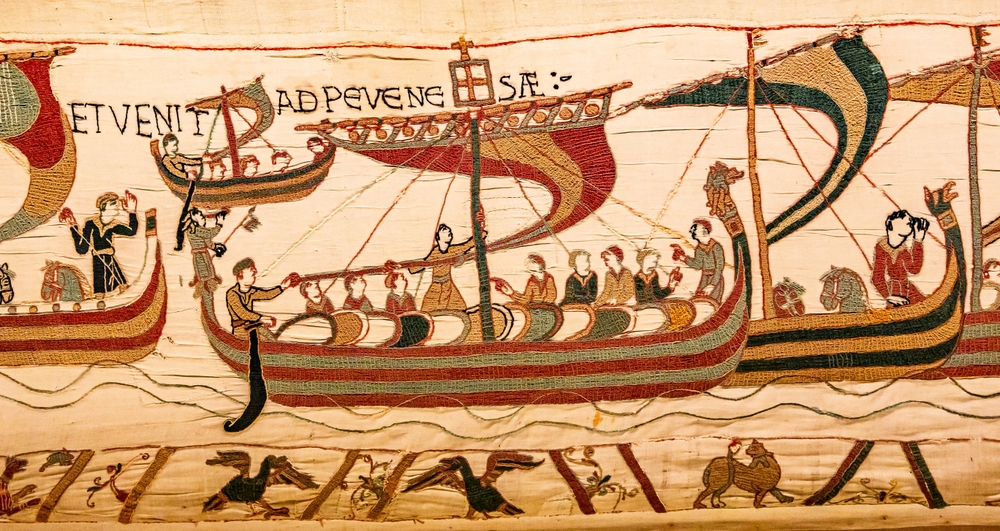
Tickets sold out in record time, and the media hype around the event continues to grow – as the public prepares to view the Bayeux Tapestry for the first time on British soil in 1,000 years, business group Logistics UK is spotlighting the complex logistical operation behind bringing such an ancient historical artifact back to England. While excitement builds for what will surely be one of the most memorable exhibitions of the year, which opens on 10 September, the safe arrival of the tapestry at the British Museum is down to the expertise of the logistics sector, explains Ben Fletcher, Chief Executive of business group Logistics UK:
“Viewing the Bayeux Tapestry is set to be a once in a lifetime experience for the tens of thousands getting ready to visit,” he said. “While the history of the tapestry and the story it tells is well known, what may not be common knowledge is the scale of the logistics operation involved in ensuring it arrived safely at the British Museum.
“Being almost 1,000 years old, 70 metres long and extremely fragile with pre-existing holes and tears in the fabric, transporting the tapestry represented a significant challenge for the teams involved, whose aim was to minimise the risk of damage during its journey. Preparation included performing dry test runs of a replica with vibration monitoring equipment, and engineering a specialist crate to absorb any shocks during the journey, while security was implemented on the route to safeguard the artefact.”
And, Mr Fletcher continued, the movement of the Bayeux Tapestry required the use of road and rail systems, as it travelled from France to England using LeShuttle, with the final stretch of its journey on the M20:
“LeShuttle is a 24-hour operation and critical for the delivery of goods between mainland Europe and Great Britain. Over half of all goods traded between the two travels across the Short Straits, with 16,000 freight vehicles moving through the Port of Dover and Eurotunnel every day. It is thanks to this seamless operation that the tapestry reached the British Museum safely and without incident.”
The successful transportation of the Bayeux Tapestry reflects how integral specialist transport is in ensuring the preservation of historical objects during movements.
“Specialist transportation is critical for moving artefacts, which can have specific requirements and sustain damage if they are not handled properly and monitored in transit,” added Mr Fletcher. “It requires teams to look at a whole host of conditions unique to the artefact, such as the environment, mode of transport and the risks involved.
“From textiles and tapestries to sculptures, fossils and treasures, logistics firms are responsible for the safe and secure movement of these fragile objects, which not only have significant financial value attached to them, but emotional too.”
To find out more about careers in logistics, visit www.generationlogistics.org.
Logistics UK is one of the UK’s biggest business groups, representing logistics businesses which are vital to keeping the UK trading, and more than seven million people directly employed in the making, selling and moving of goods. With decarbonisation, new technology and other disruptive forces driving change in the way goods move across borders and through the supply chain, logistics has never been more important to UK plc. Logistics UK supports, shapes and stands up for safe and efficient logistics, and is the only business group which represents the whole industry, with members from the road, rail, water and air industries, as well as the buyers of freight services such as retailers and manufacturers whose businesses depend on the efficient movement of goods. For more information about the organisation and its work, please visit logistics.org.uk
Transport & Logistics Magazine – Driving The Industry Forward