



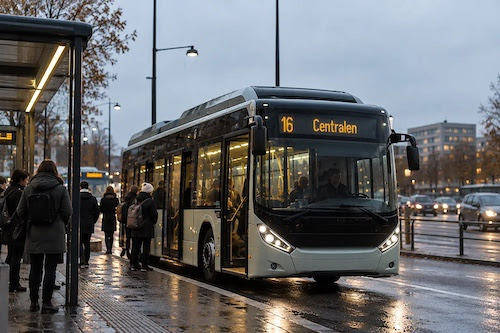
Most of the conversation around zero-emission public transport still centres on the powertrain. Battery chemistry, fuel cell durability, charging strategy and range dominate the engineering agenda, and rightly so. Yet the shift to battery electric, hydrogen fuel cell and hybrid vehicles also brings a significant data challenge.
As vehicle network architectures become more sophisticated, engineers increasingly need visibility across multiple communication networks and electronic control units (ECUs) to understand how different systems interact, both during development and in real-world operation. The challenge is no longer simply collecting more information, but ensuring it can be accessed, correlated and interpreted to provide a meaningful picture of vehicle performance.
Understanding increasingly complex vehicle systems
Modern public transport vehicles integrate increasingly complex systems spanning the powertrain, batteries, thermal management, heating, ventilation and air conditioning (HVAC), braking and safety. These systems are managed by interconnected ECUs communicating across multiple in-vehicle networks.
As these systems become more tightly integrated, analysing individual components in isolation can make it difficult to understand overall vehicle behaviour. A fault originating in one system may trigger a cascade of secondary errors across other systems, meaning the warning or fault code reported by an ECU does not necessarily indicate where the problem originated.
Engineers therefore need access to information across relevant vehicle communication networks to reconstruct the sequence of events, identify the root cause and determine the appropriate corrective action.
However, collecting large volumes of data does not automatically provide this visibility. Information from different systems must be captured with sufficient context and timing accuracy to establish relationships between events. Without this, engineers can be left with fragmented data that makes effective fault diagnosis more difficult.
Connecting development with real-world performance
The value of vehicle data extends beyond diagnostics. Operational information provides an important link between simulation, testing and vehicles in service, allowing manufacturers to validate engineering assumptions against real-world performance.
While controlled testing remains essential, buses operate across varying temperatures, passenger loads, routes and driving conditions that can be difficult to replicate fully during development.
For electric vehicles, these factors can significantly influence energy consumption and operational range. Access to detailed vehicle data enables engineers to understand these variations, validate simulations and identify opportunities to optimise vehicle performance.
As new technologies are introduced, this feedback between vehicles in operation and engineering teams will become increasingly valuable.
Supporting maintenance and fleet reliability
For fleet operators, access to meaningful vehicle data can also support more informed maintenance decisions. Remote diagnostics enable engineering teams to investigate faults and assess vehicle condition without relying solely on physical inspections. Monitoring operational trends in real time may also help identify emerging issues that warrant attention before they lead to vehicle failures or unplanned downtime.
Looking further ahead, combining historical and real-time data could support increasingly predictive maintenance strategies, allowing manufacturers and operators to identify patterns that precede component failures.
However, achieving this depends on the quality and consistency of the underlying information. Simply collecting more data will not improve maintenance outcomes unless it can be translated into practical engineering insight.
Data throughout the vehicle lifecycle
Public transport vehicles typically remain in service for 15 years or more, making long-term access to operational data an important consideration.
Information initially used for development and validation can continue to support diagnostics, maintenance, battery health monitoring and warranty analysis throughout a vehicle’s operational life.
At the same time, vehicle technologies, customer expectations and safety requirements continue to evolve. Standards such as Transport for London’s Bus Safety Standard illustrate the changing demands placed on manufacturers and the importance of maintaining access to relevant safety and operational data.
This creates a need for flexible data infrastructure capable of supporting vehicles throughout their operational life. As vehicle network architectures, regulatory requirements and customer expectations evolve, the infrastructure must be able to accommodate changing monitoring requirements rather than being limited to those defined during the original vehicle development programme.
Turning vehicle data into engineering insight
The need for better data is ultimately technology-neutral. Battery electric, hydrogen fuel cell and hybrid vehicles have different engineering characteristics, but all rely on increasingly sophisticated and interconnected electronic systems.
As public transport manufacturers introduce new technologies, the ability to capture, correlate and interpret information across multiple in-vehicle communication networks will become increasingly important for understanding vehicle performance, investigating faults and supporting long-term fleet operations.
The challenge is not simply collecting more vehicle data, but ensuring it remains accessible, reliable and useful throughout the vehicle’s operational life.
Ultimately, the next generation of public transport will depend not only on the technologies powering vehicles, but also on the data infrastructure that enables manufacturers and operators to understand how those vehicles perform in the real world.
Transport & Logistics Magazine – Driving The Industry Forward