

Rail weather alert:Remote monitoring is key to staying ahead of the weather and keeping rail services on track By James Stewart, DYWIDAG Structural Health Monitoring Technology Director
Recent extreme weather events in the UK not only posed a public health risk, they challenged the integrity of rail infrastructure vulnerable to spells of intense heat.
In Lingwood, Norfolk, the barometer reached 37.7C on June 26th, a UK record for the time of year. The searing heatwave, the second of the summer, was preceded by huge storms and torrential rainfall across southern England.
Climate change has increased the frequency of similarly disruptive weather patterns. Met Office data shows that nine of the 10 hottest days ever recorded in the UK have occurred since 1990. The trend is forecast to continue, with the impact on our daily lives – particularly in terms of travel – becoming more profound.
As June’s weather event proved, train delays and cancellations are a frustrating fact of life when outside temperatures climb to exceptional levels. As well as causing passenger disquiet, rail service disruption leads to reduced productivity, missed business activity, and longer journey times, cumulatively impacting the UK economy.
Whilst train disorder is a major source of public annoyance and personal inconvenience, it’s important to remember that it is often the result of preventative measures taken by rail operators for the correct reason – to maintain passenger safety.
How extreme heat impacts rail performance
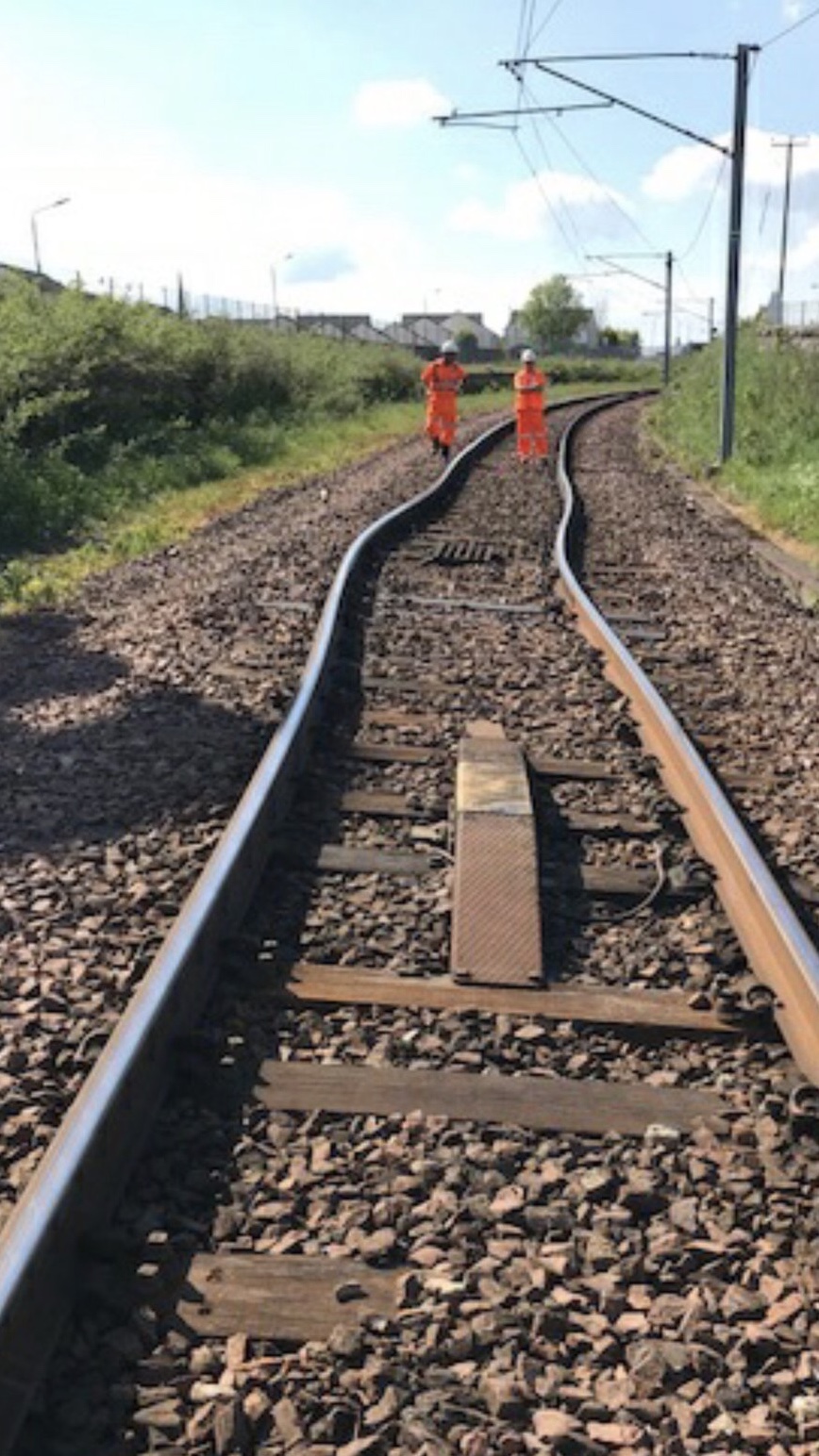
UK rail is generally installed at a ‘stress-free temperature’ (SFT) of 27-30°C. When rail temperatures exceed this level – UK rail temperatures have been recorded at more than 60°C during hot spells – the steel expands significantly over long distances. This causes compressive forces to build up in the rails, potentially moving them out of alignment to dissipate the force, leading to what the industry calls a ‘track buckle’.
Disturbed or deficient track ballast in areas where engineering work has recently taken place increases the risk of misalignment, with impact and vibration further enhancing the potential for disruption. To overcome the issue and to improve driver reaction times to visible misalignment, train speeds are reduced and staff are positioned lineside to obtain site rail temperatures every 30 minutes and look for signs of developing track misalignment.
Traditional monitoring methods
The decision to take these protective measures is informed by actual rail temperatures. Traditionally, these are obtained through manual in-person inspections by rail engineers using handheld equipment. However, such tests are labour intensive and cover a limited geographical area, whilst the data only reflects conditions at the time of inspection. This risks taking operational decisions based on information that is already out of date.
Weather forecast modelling is another established method for pinpointing trackside areas of concern during heatwaves. Again, this is fraught with operational caveats. Forecasts measure air temperature, rather than rail temperature. And with localised factors, such as track orientation, embankments and cuttings, tree cover and wind exposure significantly impacting rail temperature, different sections of track in the same vicinity may experience markedly different rail temperatures.
Remote monitoring, in the form of rail temperature sensors, has emerged as the safest and most accurate method of assessing rail locations at risk during extreme weather events. The technology includes continuous monitoring, early-warning capability and location-specific data, increasing its use across the UK rail network as a smart, fast, and reliable alternative to traditional management methods.
Remote monitoring’s role in reducing weather impact risk
DYWIDAG Smart Temp is a next-generation remote monitoring system capable of real-time, actionable temperature data every 15 minutes, with an option to increase reporting frequency as the temperature climbs. Fully integrated with Network Rail’s RADAR system, Smart Temp enables operators to pre-empt weather impacts through precise, data-driven decision-making for a safer, more efficient rail network.
Fitted with two high-strength magnets, Smart Temp is quick and easy to install. Once in situ, its strong rail-side attachment withstands heavy vibration and provides GPS location, programmable alert levels, and market-leading visualisation via DYWIDAG’s Infrastructure Intelligence (II) platform.
Infrastructure Intelligence tackles the ‘too much data, not enough time’ issue facing rail operators at decision-critical moments. Its dashboard includes configurable widgets, maps and camera feeds. This comprehensive combination simplifies complex monitoring data, provides instant situational awareness, improves site safety understanding, and enables faster, more confident operational decision-making.
The wider adoption of predictive monitoring technology is essential for taking rapid precautionary action to prevent accidents, delays and upholding rail service reliability during extreme weather conditions. The ingenuity behind solutions such as Smart Temp will be crucial to this achievement, and supporting our adaption to the world’s changing climate.
Transport & Logistics Magazine – Driving The Industry Forward